

Views: 0 Author: Site Editor Publish Time: 2025-12-26 Origin: Site


In the world of utility installation, landscaping, and residential construction, the constraints of space often dictate the success or failure of a project. Whether you are installing irrigation lines behind a pool, trenching for a new electrical conduit between a house and a property line, or laying fiber optic cable in a crowded urban alley, the requirement is the same: precision digging power delivered in a highly maneuverable package. This is precisely why the Mini Crawler Excavator has become the undisputed champion for trenching in tight spaces.
The Mini Crawler Excavator—often referred to interchangeably as a Mini Tracked Excavator—is engineered to solve the access and stability challenges that doom larger machinery. Its compact dimensions, combined with its specialized features like zero-tail swing and retractable undercarriages, make it an essential investment for any professional seeking to maximize productivity while minimizing ground disruption in confined environments. This in-depth guide explores the specialized features, operational benefits, and optimal techniques that make the Mini Crawler Excavator the best tool for precision trenching.
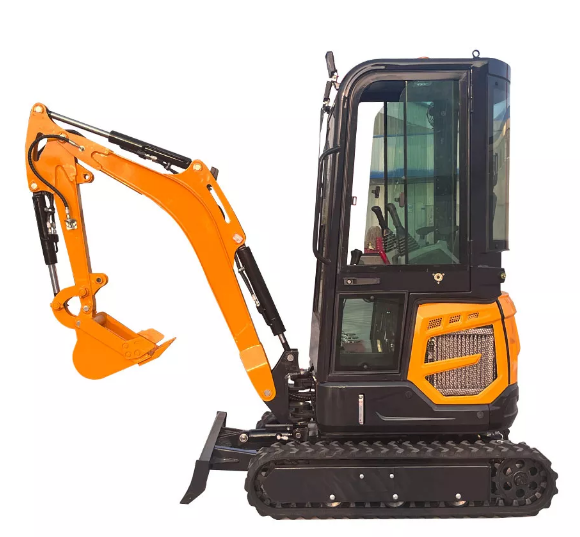
Trenching in residential neighborhoods and established commercial areas presents hazards that are almost non-existent on open construction sites:
Confined Access: Gate openings, narrow side yards, and established landscaping paths often limit machinery width to less than 40 inches (1 meter).
Utility Interference: Trenching often occurs near existing foundations, gas lines, water pipes, and communication cables. Precision, not brute force, is paramount.
Surface Preservation: Damage to finished concrete, asphalt, or lawns must be avoided. Heavy equipment leaves behind expensive restoration work.
Operational Safety: Working in close proximity to structures requires equipment that can fully rotate and swing its boom without contacting obstacles.
The Mini Crawler Excavator is specifically designed to overcome all these challenges, offering a level of control and compactness that no other machine type can match.
The specialized geometry and drive system of the Mini Crawler Excavator provide direct, measurable advantages for trenching in restricted areas.
This is perhaps the most critical feature of a modern Mini Excavator for confined space work.
Zero Tail Swing (ZTS): A ZTS model ensures that the counterweight and the house (the cab and engine compartment) do not extend beyond the width of the tracks when the operator swings the boom 360 degrees.
The Benefit for Trenching: If you are trenching alongside a structure—a foundation, a fence, or a retaining wall—a ZTS Mini Crawler Excavator can operate flush against that obstacle. This eliminates the risk of collision, increases the operator's confidence, and allows for continuous trenching without the need for constant, time-consuming repositioning of the Mini Tracked Excavator. This feature alone can cut trenching time by 20–30% in highly confined areas.
For the smallest Mini Crawler Excavator models (typically 1–2 metric tons), the retractable undercarriage is a game-changer for access.
Functionality: The machine's undercarriage can be hydraulically narrowed, often reducing the width to as little as 700 mm (28 inches)—narrower than a standard fence gate.
The Benefit for Trenching: A contractor can drive the Mini Tracked Excavator through a narrow side yard access point, then expand the undercarriage to its full working width (e.g., 1,000 mm or 39 inches) once in the backyard. This expanded stance is essential for regaining stability and lift capacity before beginning the trenching operation.
The stability offered by a Mini Crawler Excavator on its tracks is vital for digging deep, straight trenches safely.
Stability: Tracks provide a larger contact patch with the ground than tires. This low center of gravity and wide stance are paramount when the operator is making a long reach or pulling a loaded bucket of heavy soil out of the trench, preventing the Mini Tracked Excavator from tipping.
Flotation: The weight is distributed over a large area, resulting in significantly low ground pressure (often around 3.5–5.0 PSI). This is crucial when digging on soft, wet, or finished lawns, as it prevents the machine from sinking or creating deep ruts that require expensive repair. For a project focused on utility lines across a manicured property, this Mini Crawler Excavator feature preserves the client's landscape.
The efficiency of a Mini Crawler Excavator is amplified by employing best practices tailored to its capabilities:
Technique Element | Mini Crawler Excavator Best Practice | Outcome/Benefit in Tight Spaces |
Machine Alignment | Align the center of the Mini Crawler Excavator directly over the marked trench line, facing the direction of travel. | Maximizes stability for digging and ensures a perfectly straight trench path. Avoids digging over the side of the tracks, which reduces stability. |
Excavation Layering | Dig in shallow, controlled layers (e.g., 30 cm passes) along the entire length of the trench, rather than digging to full depth in one spot. | Maintains trench wall integrity, prevents soil collapse, and increases overall digging speed and consistency. |
Spoil Management | Place excavated soil (spoil) at least 0.6–1 meter (2–3 feet) away from the trench edge, always on the non-swing side (or use the blade to push spoil to one side). | Prevents cave-ins caused by overburden weight and keeps the immediate working area clear for the ZTS Mini Tracked Excavator to operate. |
Bucket Control | Use precise stick and bucket curl force, keeping the bucket's cutting edge vertical as you pull it through the soil. | Ensures the trench walls are straight and smooth, which is critical for shoring installation and clean utility laying. |
Dozer Blade Use | Always lower the dozer blade to the ground before beginning a digging pass. | Acts as a stabilizer and prevents the Mini Crawler Excavator from rocking or rolling during powerful digging cycles, enhancing the safety of the operation. |
A Mini Crawler Excavator is highly versatile because its robust auxiliary hydraulic system can power a range of trench-specific attachments.
Narrow Trenching Buckets (8–12 inches / 200–300 mm): These small buckets are essential for utility installation, as they minimize the volume of excavated material, reducing disposal and backfill costs. They are perfectly sized for small water lines, power cables, and irrigation systems.
Hydraulic Thumb: While not directly for trenching, a hydraulic thumb is invaluable for handling and placing the materials after the trench is dug (e.g., maneuvering large pipes, setting valve boxes, or handling spoil).
Plate Compactor: Once the pipe or cable is laid, the compact footprint of the plate compactor attachment, run by the auxiliary hydraulics of the Mini Tracked Excavator, allows for quick and precise compaction of the backfill, ensuring the trench area will not settle later.
While the initial purchase price of a high-spec Mini Crawler Excavator with ZTS and a retractable undercarriage may be higher than a conventional model, the return on investment (ROI) in specialized trenching work is compelling.
Cost Factor | Mini Crawler Excavator Advantage (Tight Spaces) | Economic Value |
Labor Efficiency | Mini Crawler Excavator eliminates manual digging and bucket maneuvering in tight spots. | Time savings of 4–8 hours per day over manual labor or less suitable machinery. |
Surface Damage | Low ground pressure and rubber tracks prevent damage to concrete, pavers, and lawns. | Eliminates thousands of dollars in landscape or hardscape restoration costs. |
Access & Transport | Ability to access sites through narrow gates (retractable undercarriage) and easy transport via a standard trailer. | Saves haulage costs and reduces project delay risk due to access restrictions. |
Safety | Zero-tail swing minimizes the risk of machine/structure contact. | Reduces liability claims and prevents costly machine damage. |
The ability to successfully bid and execute jobs that large equipment simply cannot access, such as backyard pool installations or complex city utility upgrades, provides a significant competitive edge and justifies the premium price of a purpose-built Mini Crawler Excavator.
The utility of the Mini Crawler Excavator is only growing with technological advancements in 2025:
Electric Powertrains: Zero-emission, low-noise electric Mini Tracked Excavator models are perfect for residential trenching, allowing work to occur earlier and later without violating local noise ordinances—a major productivity boost.
GPS/Depth Check Systems: Integrated depth check sensors are now common on premium Mini Crawler Excavator models. This technology allows the operator to set a target depth for the trench and maintain it with perfect accuracy without constantly stopping to use a measuring stick. This level of precision is critical for meeting exact grade specifications for utility lines, eliminating human error in complex trenching projects.
In conclusion, for any project where the success of the trenching operation hinges on navigating tight access, preserving surrounding structures, and maintaining pinpoint accuracy, the investment in a purpose-built Mini Crawler Excavator is not just advisable—it is essential.
The smallest class of Mini Crawler Excavator (1-ton or Micro-Excavators) equipped with a retractable undercarriage can typically retract to an overall width of 700 mm to 750 mm (28 to 30 inches). This is narrow enough to pass through most standard residential gates or doorways, making it an indispensable tool for backyard trenching.
The dozer blade on a Mini Crawler Excavator has two main trenching functions:
Stabilization: When lowered to the ground (especially on the side of the trench facing the digging operation), it acts as an outrigger, providing a solid anchor point that significantly increases the machine’s stability and lifting capacity.
Spoil Management: It is used to quickly and neatly push the excavated spoil away from the edge of the trench to prevent cave-ins, and later, for initial backfilling before final compaction.
Rubber tracks are overwhelmingly preferred because they minimize surface damage. They provide excellent traction on various surfaces, including finished concrete, asphalt, and manicured lawns, without the damaging tearing and marking that steel tracks would cause. This saves the contractor significant costs and time associated with repairing client property.
Yes. Most Mini Crawler Excavator models in the 3- to 4-ton range are capable of digging trenches to depths of 10 to 12 feet (3 to 3.7 meters). For utility trenching in the 4–6 foot range, the machine has abundant power. However, be aware that any trench deeper than 5 feet requires stringent shoring or sloping safety protocols (per OSHA guidelines) to prevent wall collapse.
The Mini Crawler Excavator must be equipped with Auxiliary Hydraulics (also known as a hydraulic thumb or hammer circuit). This secondary circuit provides the dedicated flow and pressure necessary to run high-demand, non-bucket attachments like augers for drilling post holes, breakers for penetrating rock, or plate compactors for backfilling the trench.


