

Views: 0 Author: Site Editor Publish Time: 2025-12-31 Origin: Site


The escalating pace of urbanization and the urgent need for infrastructure renewal have fundamentally changed the way construction professionals approach city-based projects. In this high-density, high-traffic environment, traditional tracked machinery often proves to be a logistical liability. Enter the Small Wheel Excavators, the specialized machine category that is redefining productivity for road repair, utility work, and urban construction in 2025 and beyond.
While the tracked Mini Excavator dominates the landscaping and residential markets, Small Wheel Excavators are engineered explicitly for the demands of the "concrete jungle." Their core value proposition centers on speed, mobility, and reduced impact on hard surfaces—factors that translate directly into lower Total Cost of Ownership (TCO) and faster project completion times for municipal and utility contractors. This comprehensive article delves into the critical advantages, data-driven efficiency gains, and operational superiority that cement the Small Wheel Excavators as the definitive choice for city-bound projects.
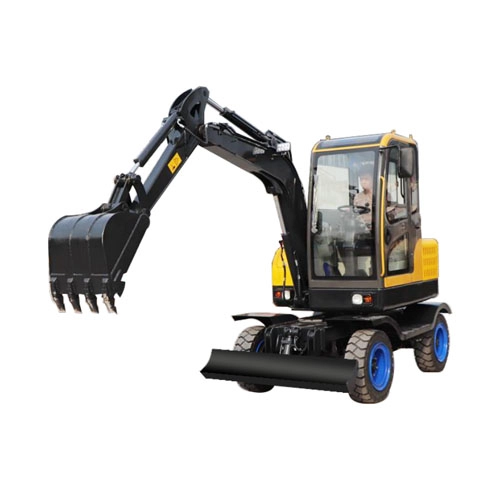
The single most decisive factor favoring Small Wheel Excavators over tracked machines in urban settings is their road-legal speed and mobility.
A standard tracked Mini Excavator is limited to travel speeds of approximately 4–6 km/h (2.5–3.7 mph). Moving it between two job sites—even just a few blocks apart—requires a dedicated haul truck, a low-boy trailer, a commercial driver, loading time, securing time, and unloading time. This non-productive time is a massive drain on project resources.
In contrast, Small Wheel Excavators are equipped with high-speed transmissions, capable of achieving road speeds of 35–40 km/h (22–25 mph), with some models pushing up to 54 km/h.
Excavator Type | Max Transit Speed | Transit Method for 5-Mile Trip | Estimated Time Cost |
Tracked Mini Excavator | 4–6 km/h | Truck + Trailer | 60–90 minutes (Loading, Transport, Unloading) |
Small Wheel Excavators | 35 km/h | Self-Drive (Road-Legal) | 10–15 minutes (Transit Only) |
For a crew working on three to five utility repairs per day across a city district, the cumulative savings in time and labor due to the Small Wheel Excavators' mobility become exponentially significant. This competitive advantage allows contractors to increase their number of billable stops per shift.
Small Wheel Excavators are designed, built, and often certified to meet stringent road regulations, including mandatory lighting, braking systems, and signalization. This compliance eliminates the regulatory and permitting headaches associated with constantly moving oversized tracked equipment, simplifying operations for busy road repair crews. They function as a mobile, self-contained unit, ready to deploy the moment they arrive at the patch of asphalt that needs to be broken up.
Urban construction overwhelmingly involves working on concrete, asphalt, or stabilized road bases. This environment is where Small Wheel Excavators truly shine.
Unlike steel tracks which can tear up pavement, or even rubber tracks which wear rapidly and leave marks on sensitive surfaces, the robust, industrial tires of Small Wheel Excavators are road-friendly. This means the machine can move around the job site, reposition, and travel on public roads without requiring the crew to lay down protective mats. In road repair, this saves time, money, and minimizes the footprint of the construction zone.
The biggest long-term cost burden for a Mini Excavator is the undercarriage—the tracks, idlers, sprockets, and rollers. On abrasive asphalt and concrete surfaces, the wear rate on these components accelerates dramatically, leading to expensive and frequent replacements.
Track Life (Abrasive Surface): Typically 1,000–1,500 hours for rubber tracks.
Tire Life (Pavement): Quality industrial tires on Small Wheel Excavators can last 3,000–5,000 hours, leading to a significantly lower TCO.
The simpler, more durable wheeled drive system of the Small Wheel Excavators results in fewer non-productive maintenance hours and a vastly reduced expenditure on replacement parts.
While tracks offer immediate, passive stability, Small Wheel Excavators achieve excellent and safe digging stability by deploying hydraulic outriggers and/or the dozer blade. When these stabilizers are firmly planted, the Small Wheel Excavators become virtually immovable, allowing them to exert powerful breakout force for breaking through old pavement or hardened concrete, a task common in road repair. The ability to deploy these stabilizers quickly ensures minimal setup time on the job site.
Modern Small Wheel Excavators are highly sophisticated, multi-functional machines that can run a wide range of specialized attachments, often using advanced high-flow auxiliary hydraulics.
Attachment | Primary Function in City/Road Repair | Efficiency Gain |
Hydraulic Breakers | Breaking through concrete, asphalt, and reinforced slabs. | Transforms the Small Wheel Excavators into a powerful, self-propelled demolition unit. |
Plate Compactors | Compacting soil and backfill in trenches (utility work). | Ensures the backfilled road patch does not settle, preventing future pavement failure. |
Trenching Buckets | Digging narrow cuts for water lines, gas pipes, and fiber optics. | Allows the Mini Excavator to precisely execute the required excavation while minimizing the size of the road opening. |
Grading Buckets | Final road leveling and smoothing. | Wide buckets, often with tilt functionality, are ideal for quickly preparing the surface for final paving or concrete pouring. |
Grapples/Thumbs | Loading broken concrete and asphalt debris directly into dump trucks. | Maximizes the loading cycle speed, keeping the road open to traffic for less time. |
This high degree of versatility means a single Small Wheel Excavators unit can often perform the functions of two or three separate specialized machines, optimizing fleet utilization and reducing the number of vehicles required at an already constrained urban job site.
It is important to note that the term Mini Excavator often refers generically to compact excavators under 6 metric tons, encompassing both tracked and wheeled models. However, when selecting for urban duty, the benefits of the wheeled platform often outweigh the superior off-road stability of the tracked version.
The sweet spot for Small Wheel Excavators in urban construction typically falls in the 10- to 20-ton operating weight class, where they offer high horsepower and deep digging capability (often down to 14–18 feet), while maintaining the essential road speed. This size ensures the machine has the reach and power to handle major city utilities and road layers that would strain a smaller tracked Mini Excavator.
2025 trends are further strengthening the position of Small Wheel Excavators in the urban environment:
Electrification: The introduction of electric and hybrid Small Wheel Excavators dramatically reduces noise levels (critical for night work in residential zones) and eliminates on-site emissions, meeting increasingly strict city environmental regulations.
Telematics and Safety: Enhanced telematics systems monitor the location, fuel consumption, and performance of the Small Wheel Excavators in real-time. Features like automatic ride control (load isolation) engage at speed to reduce boom bounce and increase safety when driving on uneven city streets.
For contractors focused on municipal tenders, utility maintenance, and rapid road repair, the operational agility and clear cost savings derived from transit efficiency make the Small Wheel Excavators an unparalleled asset.
The key advantage of Small Wheel Excavators is speed. They typically achieve travel speeds between 35 km/h and 40 km/h (22–25 mph), depending on the model and gearing. In contrast, the fastest tracked Mini Excavator models are limited to a crawl speed of around 6 km/h (3.7 mph), requiring separate, expensive transport for inter-site movement.
No. The industrial-grade rubber tires on Small Wheel Excavators are specifically designed for hard-surface use. Unlike the grousers on steel tracks or the abrasive nature of tracked operation, the tires allow the machine to maneuver and travel on finished asphalt, concrete, and paved areas with minimal or no surface damage.
Ride control, or load isolation, is a hydraulic dampening system that is automatically engaged when the Small Wheel Excavators reaches a certain travel speed (e.g., 5 km/h). It acts like a suspension system for the boom and attachment, reducing bouncing and oscillation when driving on uneven roads. This improves safety, reduces operator fatigue, and minimizes spillage when carrying materials.
Generally, yes, especially in the larger compact classes (10-20 tons). While tracked machines have a slightly lower undercarriage profile, modern Small Wheel Excavators are engineered with deep-digging arms and powerful hydraulics that allow them to match or closely approach the digging depth and reach of comparable tracked excavators, often reaching depths of 15 to 18 feet to handle major utility lines.
While general safety rules apply to all machinery, Small Wheel Excavators inherently reduce risk factors common in city work. Their high travel speed minimizes the time the machine is blocking traffic during transit. Furthermore, modern Small Wheel Excavators often have large cabs with excellent visibility and standard road safety features (mirrors, lights, signals) that make them safer to operate alongside cars and pedestrians than conventional tracked equipment.


