

Views: 0 Author: Site Editor Publish Time: 2025-12-19 Origin: Site


In the residential and commercial landscaping industry, the Mini Excavator is no longer a luxury—it is an indispensable tool. The demands of modern garden work, from installing elaborate water features to complex utility trenching in tight backyards, require a machine that marries power with precision and, crucially, minimal ground disturbance.
This comprehensive guide focuses on the ideal specifications and features that make a Mini Excavator the best choice for landscaping professionals. We specifically examine the Mini Tracked Excavator, the most prevalent type in this sector, and the evolving role of the broader Compact Excavator category in the year 2025. By understanding the latest trends in size, power-to-weight ratio, and attachment compatibility, you can ensure your investment yields maximum productivity and profitability on every project.
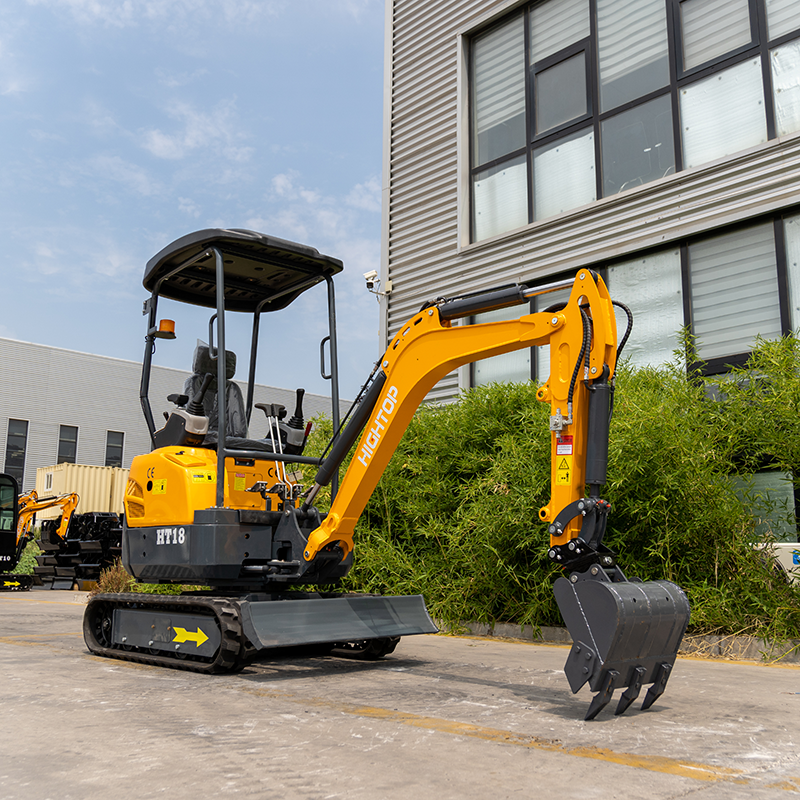
The core principle of landscaping is transformation with minimal disruption. Full-sized excavators are too bulky and destructive for residential properties. The Mini Excavator, typically weighing between 1 and 6 metric tons (2,200 to 13,000 lbs), delivers brute force in a compact excavator package that is perfectly suited for these environments.
Several 2025 trends highlight why the Mini Excavator is increasingly dominating landscaping:
Zero and Reduced Tail Swing: Some Manufacturers are emphasizing zero-tail swing (ZTS) designs. A Mini Excavator with ZTS can rotate its cab 360 degrees within the width of its tracks, allowing the operator to work flush against a fence, wall, or house foundation without risking damage—an essential feature for garden work.
Electric Models (The Quiet Revolution): The rise of electric Mini Excavator models addresses the need for quiet operation in noise-sensitive residential neighborhoods. Zero emissions and low decibel levels allow landscapers to work earlier in the morning or later in the evening, extending billable hours without violating local noise ordinances.
Intelligent Hydraulics: New models feature load-sensing hydraulics that automatically adjust power output. This means smoother composite movements (swinging and booming simultaneously) and more precise control, which is critical when digging near delicate utility lines or grading fine soil.
When selecting the best Mini Excavator for landscaping and garden work, the platform of choice is almost exclusively the Mini Tracked Excavator (often called a Mini Crawler Excavator). This design provides the necessary flotation and stability for soft, uneven ground.
This is arguably the single most important feature for a landscaping Mini Excavator.
Many older residential properties have access points—fence gates, narrow side yards, or small sheds—that are just 36 inches (915 mm) wide. A truly compact excavator must be able to pass through this opening. Look for Mini Tracked Excavator models in the 1 to 2.5-ton class that offer a hydraulically adjustable, or retractable, undercarriage.
Optimal Width: The tracks should retract to approximately 980 mm (39 inches) or less.
Operation: The operator can retract the tracks to enter a narrow passage, and then extend them back out to the working width (often up to 1,300 mm or 51 inches) to regain maximum lifting stability.
Landscaping involves working on finished surfaces: lawns, soft soil, new sod, and mulch beds. The Mini Tracked Excavator excels here because its weight is spread across the entire track area, resulting in very low ground pressure (typically 28–35 kPa).
Benefit: This low pressure minimizes soil compaction—a key concern for healthy gardens and trees—and prevents the machine from creating deep, expensive ruts, allowing the Mini Excavator to "tread lightly" where wheeled machines would struggle.
While garden trenches are not as deep as major commercial utility lines, a quality Mini Excavator still needs sufficient reach for tasks like:
Installing French drains or weeping tiles (often 4–6 feet deep).
Removing medium-sized tree stumps.
Digging footing holes for retaining walls.
A compact excavator in the 3-ton class will typically provide a digging depth of 10 to 12 feet (3 to 3.7 meters) and a ground-level reach of up to 16 feet, which is more than enough capability for 95% of landscaping projects.
A Mini Excavator’s true value in landscaping is its versatility as a tool carrier, driven entirely by its auxiliary hydraulic flow. Landscaping attachments require significant power, which is provided by the auxiliary hydraulic circuit.
Standard Flow (10–20 GPM): Sufficient for standard attachments like augers, hydraulic thumbs, and tilt buckets.
High Flow (20–40 GPM): Required for demanding, high-production attachments that make a Mini Excavator truly versatile, such as:
Brush Cutters/Mulchers: Necessary for clearing overgrown brush and small trees. These require high GPM (gallons per minute) to maintain blade speed and torque when cutting thick material.
Rock Saws/Trenchers: For cutting narrow trenches in solid rock or frozen ground.
When evaluating a Mini Tracked Excavator, always check the Auxiliary Hydraulic Flow Rate to ensure it meets the demands of your specialized attachments.
Attachment | Primary Landscaping Use | Benefit for Compact Excavator |
Hydraulic Thumb | Placing boulders, stacking rock walls, handling logs, brush clearing | Turns the bucket into a versatile gripper, significantly improving material handling speed. |
Auger | Drilling holes for fence posts, planting large trees/shrubs | Rapidly creates uniform holes with less manual labor than post-hole diggers. |
Tilt/Swivel Bucket | Final grading, shaping earth berms, ditch cleaning | Allows the operator to tilt the bucket up to 45 degrees left or right, eliminating the need to constantly reposition the Mini Excavator for fine grading. |
Flail Mower/Brush Cutter | Clearing overgrowth, lot preparation, invasive species removal | Transforms the machine into a powerful land-clearing tool. |
Ripper Tooth | Breaking up hard clay, frost, or removing stubborn tree roots | Concentrates breakout force into a single point for efficient ground penetration. |
While the Small Wheel Excavator has merits in urban utility work (as discussed in other analyses), the Mini Tracked Excavator is overwhelmingly the superior choice for private and commercial landscaping, due to:
Gradeability and Slopes: Landscaping often involves terracing and working on slopes. Tracks provide the stability and traction to safely traverse and operate on inclines that would challenge a wheeled machine.
Zero-Tail Swing & Retractable Tracks: The combination of fitting through a narrow gate and working alongside a wall is unique to the Mini Tracked Excavator.
Hydrostatic Drive: The continuous contact of the tracks provides superior control for delicate grading and positioning tasks that require subtle movements—precision that is non-negotiable in garden design.
The Mini Excavator category is diverse. Matching the weight class of your Compact Excavator to your typical workload is key to maximizing efficiency and controlling costs.
Weight Class (Operating Weight) | Target HP Range | Ideal Landscaping Use Cases | Key Feature to Look For |
Micro (1–2 Ton) | 10–20 HP | Backyard access, pool/patio prep, small trenching, tight spaces. | Retractable Undercarriage (Must fit 36" gate). |
Small (2–3.5 Ton) | 20–30 HP | Standard residential, mid-sized stump removal, retaining walls, utility line installation. | Zero Tail Swing and strong lifting capacity. |
Medium (3.5–5 Ton) | 30–40 HP | Commercial grounds, large tree planting, heavier demolition, operating high-flow mulchers. | High-Flow Auxiliary Hydraulics for production attachments. |
Choosing a Mini Excavator that is too large means higher transport costs, greater fuel consumption, and increased risk of ground damage. Choosing a machine that is too small means slow cycle times and insufficient breakout force for tough jobs like pulling out large roots. The 2.5 to 3.5-ton class is generally considered the "sweet spot" for a versatile landscaping Compact Excavator.
Landscaping contractors often spend long hours in the cab. The best Mini Excavator models of 2025 focus heavily on operator comfort:
Ergonomics: Look for adjustable, air-ride suspension seats, low-effort joysticks with proportional hydraulic control, and clear sightlines.
Climate Control: A climate-controlled cab is a major selling point for operator retention and comfort during long summer days—a significant upgrade over open-canopy models.
Reliability: Brands known for durable engines and reliable hydraulic systems (Kubota, Cat, Bobcat) tend to command higher resale values, ensuring that your Mini Tracked Excavator remains a valuable asset for years to come.
Ultimately, the right Mini Excavator for landscaping is a Mini Tracked Excavator that can fit where a human can walk, has the hydraulic muscle to run powerful tools, and is reliable enough to earn money every day.
The main benefit of a ZTS Mini Excavator is the ability to swing the boom and cab 360 degrees without the rear of the machine extending beyond the width of the tracks. In a confined backyard, this means the operator can work directly alongside a fence, house, or property line without pausing or repositioning the entire Compact Excavator, drastically increasing productivity and preventing property damage.
Most Mini Excavator models under 3.5 tons (7,700 lbs) are legally towable behind a heavy-duty pickup truck (like a Ford F-250 or equivalent) using a standard trailer. When considering your total transport weight, you must include the machine's operating weight, the weight of the trailer itself, and any attached buckets or tools. Always verify your truck's towing capacity and local licensing requirements.
Electric Mini Excavator models are gaining traction primarily because they operate with zero emissions and are significantly quieter than their diesel counterparts. In residential settings, this eliminates complaints about exhaust fumes and noise, allowing landscaping teams to begin work earlier and avoid costly operational hour restrictions.
Yes, a Mini Tracked Excavator is highly effective at stump removal, particularly when equipped with the right attachments. While the bucket can be used to dig out the roots, using a specialized Ripper Tooth attachment is much more efficient. The Compact Excavator utilizes its powerful boom and bucket cylinders to pry and tear the root ball out of the ground.
The dozer blade is extremely important and multifunctional on a landscaping Mini Excavator. It serves three critical purposes: Stability (used as an outrigger during digging/lifting), Leveling (for backfilling trenches and rough grading), and Clean-up (pushing soil, mulch, and debris into piles). A Mini Tracked Excavator with a four-way angle blade offers the ultimate versatility for final grade finishing.


